





Horror Movie Logline Examples: How to Write a Horror Logline That Hooks Producers
A great horror movie begins with an idea that makes someone want to know what happens next. Before a producer reads your screenplay, that idea often needs to work in a single sentence: your logline.
Whether you’re developing psychological horror, supernatural horror, a slasher, or a contained thriller, a strong horror screenplay logline communicates the central conflict, establishes the stakes, and introduces a disturbing hook.
In this guide, we’ll break down what makes an effective horror logline, examine original horror movie logline examples, and explore how writers can turn a promising concept into a compelling pitch.
Quick Answer: What makes a good horror movie logline?
A good horror movie logline identifies the protagonist, the threat, the central conflict, and the stakes in approximately 25–40 words. It should also reveal the story’s distinctive horror hook: the unsettling idea that makes the movie different from other films in the genre.
1. What Is a Horror Movie Logline?
A horror movie logline is a brief description of a screenplay’s central premise. It tells a potential reader who the story follows, what terrifying problem the character faces, and what may happen if they fail.
Unlike a synopsis, a logline doesn’t explain every major plot point. Its purpose is to communicate the core dramatic engine of the story and generate interest.
A logline is particularly important when approaching producers, managers, agents, and production companies. It may be the first piece of writing they encounter from your project.
If you’re preparing to approach industry professionals, read our related guide: How to Pitch a Horror Screenplay to Producers .
2. The Essential Elements of a Horror Logline
Most effective horror loglines contain five essential elements. Not every logline uses them in the same order, but each helps the reader understand why the story is worth exploring.
The Protagonist
Who is the central character? Instead of simply writing “a woman” or “a man,” identify the character through a relevant quality, profession, relationship, or personal struggle.
For example, “a grieving mother” immediately suggests emotional vulnerability and potential psychological conflict.
The Inciting Incident
What happens that disrupts the protagonist’s life? This is often the moment the horror begins: an unsettling discovery, an unexpected arrival, or an event that cannot be explained.
The Horror Threat
What makes the situation frightening? The threat could be a supernatural entity, a human predator, a dangerous environment, or the protagonist’s own deteriorating perception of reality.
The Central Conflict
What must the protagonist do? Strong loglines suggest a clear objective rather than simply describing a series of frightening experiences.
The Stakes
What happens if the protagonist fails? Death may be an obvious possibility in horror, but emotional stakes such as losing a child, sacrificing a loved one, or confronting a devastating truth can make the premise more compelling.
3. A Simple Horror Movie Logline Formula
A useful starting structure is:
When [a disturbing event occurs], [a specific protagonist] must [pursue a clear objective] before [a terrifying consequence], while confronting [the unique horror complication].
This is a drafting tool, not a rigid rule. The finished sentence should sound natural, create tension, and communicate the story without feeling like a checklist.
4. Original Horror Movie Logline Examples
The following are original, illustrative loglines created to demonstrate different approaches to horror storytelling. They are not descriptions of Brian M. Wixson’s existing screenplays or projects being offered for sale.
Example 1: Psychological Horror
After moving into an isolated house to recover from a breakdown, a grieving therapist begins receiving recordings of conversations she hasn’t had yet—and must discover who’s making them before the recordings predict her daughter’s death.
Why it works: The protagonist has an emotional vulnerability, the threat is unsettling but understandable, and the recordings introduce a clear mystery with escalating personal stakes.
The premise also creates an immediate question: Are the recordings supernatural, manufactured, or connected to the therapist’s mental state?
Example 2: Supernatural Horror
When a rural church begins receiving confessions from people who died decades earlier, a skeptical young priest must uncover what is speaking through the confessional before the voices persuade his congregation to commit a final act of devotion.
Why it works: The setting, threat, and conflict are immediately recognizable. The premise suggests supernatural dread, a distinctive mechanism, and a protagonist whose beliefs will be tested.
Example 3: Contained Horror
Trapped overnight in an office elevator with four strangers, a security guard discovers that every time the doors open, one passenger is replaced by someone who knows a secret from his past.
Why it works: The location is contained, the horror mechanism is easy to visualize, and the protagonist has a personal connection to the escalating threat.
A contained setting can also help producers quickly understand the project’s potential production scope, although the final budget depends on many factors beyond location count.
Example 4: Slasher Horror
When cast members of an unfinished slasher film begin dying in the exact order of its abandoned script, a former child actor must identify the killer before the movie’s unwritten ending becomes her own.
Why it works: The premise establishes a recognizable subgenre while introducing a specific twist. The connection between the screenplay and the murders creates a built-in structure for suspense.
Example 5: Folk Horror
After inheriting her family’s remote orchard, a city-raised teacher discovers the villagers have kept it fertile through an annual ritual—and that her return has made her the next offering.
Why it works: The setting and ritual suggest a strong atmosphere, while the family inheritance connects the protagonist personally to the danger.
Example 6: Found-Footage Horror
While livestreaming an investigation inside an abandoned hospital, three documentary filmmakers discover their broadcast is showing events ten minutes into the future—including the deaths of everyone watching.
Why it works: The premise uses the filmmaking format as part of the horror itself. The ten-minute prediction creates urgency, and the threat expands beyond the people physically inside the hospital.
5. Weak vs. Strong Horror Logline Examples
Many horror writers struggle because their first logline describes the genre rather than the actual story.
Weak Logline
A group of friends visits a haunted house and experiences terrifying supernatural events.
This tells us the story involves friends, a haunted house, and supernatural activity, but it doesn’t establish a distinctive conflict or specific stakes.
Stronger Logline
When five estranged friends reunite at the house where their classmate vanished, they discover the building recreates their childhood memories—and erases one of them each time someone tells a lie.
The revised version introduces a meaningful relationship between the characters, a unique horror mechanism, and a source of escalating conflict.
It also raises a dramatic question: What happened to the missing classmate, and what are the friends hiding?
6. What Makes a Horror Logline Stand Out?
A logline becomes more memorable when its elements work together rather than simply presenting a monster, location, or frightening situation.
- A distinctive hook: An idea that can be explained quickly but suggests surprising possibilities.
- An emotionally relevant protagonist: Someone whose fears, choices, or relationships matter to the central conflict.
- A clear horror mechanism: A specific rule, threat, or pattern that helps audiences understand the danger.
- Escalating consequences: A situation that becomes more difficult as the protagonist takes action.
- Visual storytelling potential: A premise that suggests compelling scenes rather than relying entirely on exposition.
For producers evaluating multiple projects, clarity is valuable. A distinctive idea is more useful when the reader can immediately understand what kind of film it could become.
7. How Long Should a Horror Movie Logline Be?
A practical target is approximately 25–40 words, although there is no universal industry rule. Some strong loglines are shorter, while complex premises occasionally need a few additional words.
The goal isn’t to hit an exact number. It’s to deliver enough information to make the concept clear without turning the logline into a miniature synopsis.
If your logline exceeds 50 words, consider whether it includes unnecessary character names, backstory, secondary plotlines, or explanations of the mythology.
8. Common Horror Logline Mistakes
Being Too Vague
Phrases like “terrifying events unfold” and “nothing is what it seems” don’t communicate what actually makes the movie frightening.
Revealing Too Much
A logline should establish the conflict, not explain the final twist or resolve the mystery.
Introducing Too Many Characters
Focus on the central protagonist or a clearly defined group. Too many names and relationships make the premise harder to follow.
Confusing Atmosphere With Story
A remote cabin, abandoned asylum, or dark forest may provide atmosphere, but setting alone doesn’t create dramatic momentum. The protagonist needs a problem that demands action.
Forgetting the Emotional Stakes
Horror becomes more engaging when the audience understands what the protagonist stands to lose beyond physical survival.
9. How to Test Your Horror Logline
Before including a logline in a query email, pitch deck, or screenplay submission, evaluate it with a simple five-question test.
- Can someone identify the protagonist after one reading?
- Is the central horror threat clear?
- Does the protagonist have a recognizable goal or urgent problem?
- Are the consequences of failure understandable?
- Does the premise contain a memorable element that distinguishes it from similar horror films?
Read the logline aloud. If you need to explain the premise immediately afterward, the sentence may still need refinement.
Another useful exercise is to remove the title and ask a reader what kind of movie they imagine. Their answer can reveal whether the logline communicates the intended genre, scope, and tone.
10. Using Your Logline to Pitch a Horror Screenplay
A logline isn’t just a writing exercise. It’s a practical tool for communicating a project’s value.
It can appear in a query email, pitch deck, one-page synopsis, screenplay listing, or conversation with a potential collaborator.
When presenting a horror project, the logline should accurately reflect the screenplay. A sensational hook may attract attention initially, but it won’t help if the actual script delivers a completely different story.
The strongest pitch materials work together: the logline establishes the concept, the synopsis demonstrates the narrative, and the screenplay delivers on the promise.
For a more detailed breakdown of the professional pitching process, see How to Pitch a Horror Screenplay to Producers: A Practical Guide for Horror Writers .
11. Frequently Asked Questions About Horror Loglines
What is an example of a horror movie logline?
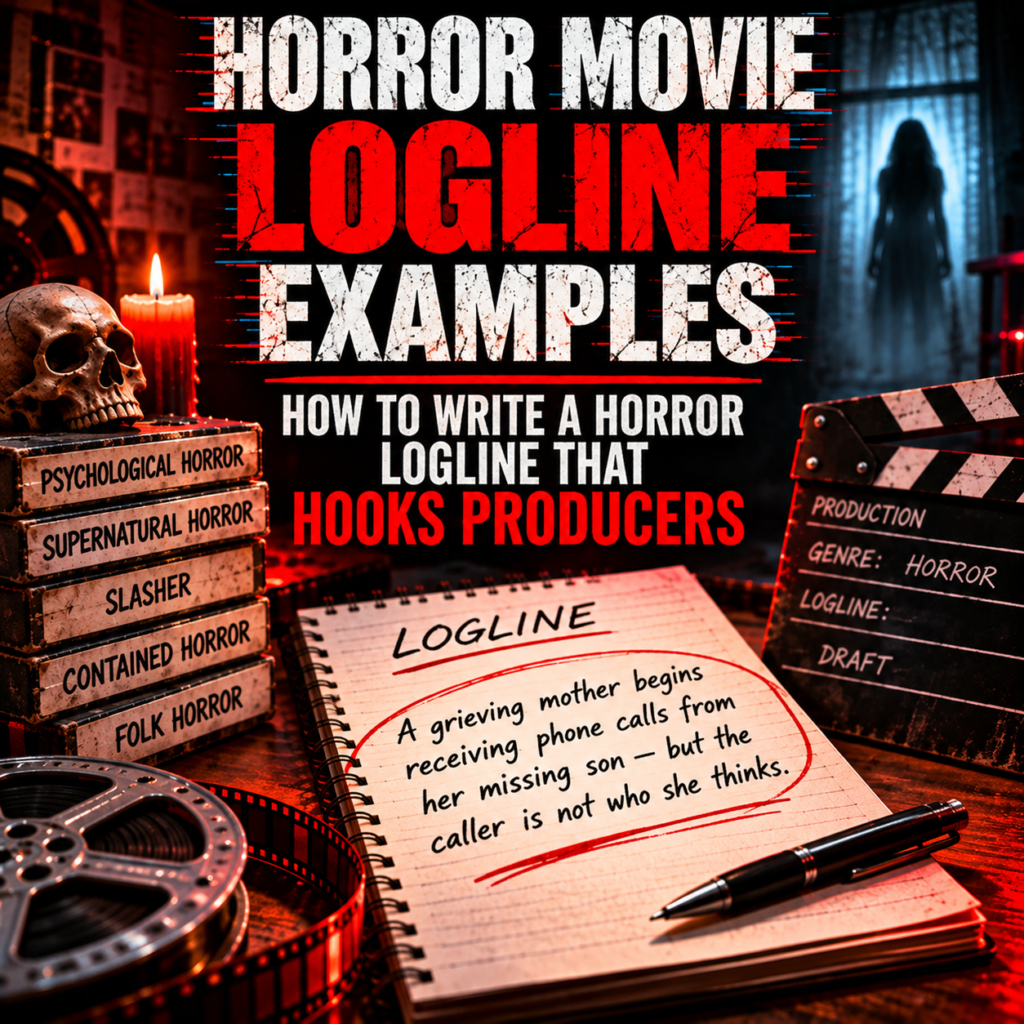
An original example is: “When a grieving mother begins receiving phone calls from her missing son, she must uncover who is speaking through his disconnected number before the caller convinces her to bring him home.”
How many sentences should a horror logline be?
Most horror loglines work best as one sentence, although a two-sentence version can be effective when necessary. Clarity matters more than a strict sentence count.
Should a horror logline reveal the monster?
Only if revealing the monster or threat helps explain the central premise. You can preserve mystery while still describing the nature of the danger clearly enough to make the conflict understandable.
Can a horror logline include a twist?
Yes. A premise-level twist can be the feature that makes a horror story distinctive. However, avoid revealing a major ending twist that the screenplay depends on keeping secret.
What is the difference between a logline and a synopsis?
A logline summarizes the central premise in one or two sentences. A synopsis describes the story’s major events, character progression, and resolution in substantially more detail.
Do producers care about horror movie loglines?
A clear logline can help producers and other industry professionals assess whether a project’s premise aligns with their interests. It is one part of the evaluation process, not a substitute for a strong screenplay.
Final Thoughts: Sell the Story, Not Just the Scare
The best horror movie loglines don’t simply promise frightening events. They introduce a character, establish a disturbing conflict, and make the reader curious about what happens next.
Whether your story is built around psychological dread, supernatural terror, or a contained survival scenario, the same principle applies: give the audience a compelling reason to care before you give them a reason to be afraid.
A strong logline won’t guarantee a screenplay sale, but it can help your concept communicate its potential more effectively to the people evaluating it.
Written By Brian M. Wixson
Horror Screenwriter and Author
Brian M. Wixson writes horror fiction and screenplays, with a focus on psychological tension, memorable premises, and emotionally grounded storytelling.
Explore more articles at Industry Insights .