






How to Pitch a Horror Screenplay to Producers: A Practical Guide for Horror Writers
A frightening idea might get someone’s attention. A professional pitch gives that idea a chance to become a movie.
Quick Answer: To pitch a horror screenplay to producers, prepare a compelling logline, a polished script, a concise synopsis, and a professional introduction. Research producers whose previous projects align with your story, follow their submission policies, and communicate the premise, genre, audience, and production scope clearly. A pitch deck can provide additional support when requested or appropriate. The objective of the initial pitch is to earn a conversation or a request to read the screenplay.
For horror screenwriters, finishing a screenplay is only one part of the process.
The next challenge is getting the right people interested enough to read it.
That means understanding how to present a project, identify suitable production companies, communicate its potential, and approach the industry without wasting opportunities.
A producer may receive numerous pitches, referrals, and submissions.
Your job is not to explain every frightening moment in your screenplay.
It’s to communicate why this particular story deserves further consideration.
What Does It Mean to Pitch a Horror Screenplay?
A screenplay pitch is a presentation designed to generate interest in a film project.
It can happen through an email, a scheduled meeting, a film market, an industry introduction, or a conversation with a producer or development executive.
Not every pitch looks the same.
An introductory email might contain only a few paragraphs.
A formal pitch meeting may involve a structured presentation, visual materials, and a discussion of the project’s potential.
Regardless of the format, an effective horror pitch should answer five questions:
- What is the movie about?
- Who is the central character?
- What makes the horror distinctive?
- Who is the intended audience?
- Why is this project worth developing?
These questions are different from the broader question of what makes a screenplay commercially appealing.
A completed script demonstrates your ability to tell a story.
A pitch demonstrates your ability to communicate that story to someone who hasn’t read it.
Both skills matter.
What Should Be Included in a Horror Screenplay Pitch Package?
Before approaching producers, make sure your materials are ready.
A professional horror screenplay pitch package may contain several components, although not every producer will request all of them.
A Polished Screenplay
The script should be complete, properly formatted, revised, and ready for professional consideration.
Don’t pitch an unfinished feature as though the screenplay is ready to be read.
If you’re pitching a concept rather than a completed script, make that distinction clear.
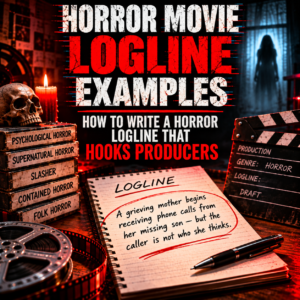
A One-Sentence Logline
Your logline should establish the protagonist, central conflict, and compelling element that distinguishes the story.
Consider this fictional example:
A night-shift security guard discovers that every person who appears on the hospital’s surveillance monitors will die before sunrise—unless he enters the locked rooms where the cameras are filming.
The premise immediately creates questions.
Who is controlling the cameras?
Why are the rooms locked?
What happens when the guard appears on a monitor himself?
Those questions generate curiosity without requiring a lengthy explanation.
A One-Page Synopsis
A synopsis explains the main story, including its resolution.
Unlike a teaser or marketing description, a synopsis should not conceal the ending merely to preserve a surprise.
Its purpose is to help someone evaluate the narrative.
A Short Writer Biography
Include a concise, accurate biography that establishes your relevant experience and connection to the material.
Relevant published work, produced credits, writing experience, or other legitimate professional accomplishments may be included.
Avoid inflated claims or unrelated personal details.
An Optional Horror Film Pitch Deck
A visual presentation can help communicate tone, setting, atmosphere, and the project’s intended identity.
However, a pitch deck is not automatically necessary for every submission.
Some producers prefer a logline and script.
Others may request a synopsis, treatment, or additional development materials.
Prepare useful materials, but submit only what the recipient requests or permits.
Build Your Horror Pitch Around the Audience Experience
Horror offers a particular challenge when pitching.
You cannot reproduce the entire emotional experience of watching the movie in a short meeting.
You have to suggest that experience.
A good horror pitch communicates what the audience will fear, how the tension develops, and what makes the experience memorable.
For example, instead of saying:
This is a supernatural horror movie about a haunted apartment.
Consider:
Every night, a tenant hears her missing daughter’s voice coming from the apartment upstairs. The building manager insists that the apartment has been empty for thirty years.
The second description introduces an emotional connection, a mystery, and an unsettling contradiction.
It gives the listener a reason to want more information.
When preparing your pitch, identify the central audience experience.
Is the film designed to create claustrophobia?
Paranoia?
Dread?
Suspicion?
A sense that familiar surroundings have become dangerous?
A pitch should communicate that experience without becoming a scene-by-scene retelling.
How to Find Producers Interested in Horror Screenplays
One of the most important steps in pitching is identifying appropriate recipients.
Sending the same generic message to dozens of unrelated companies is rarely an effective strategy.
Instead, research producers and production companies whose work demonstrates an interest in projects similar to yours.
Look at:
- Films they have recently produced or developed.
- Whether they work primarily in horror, thriller, or adjacent genres.
- The scale and style of their previous productions.
- Whether they develop original material or focus on existing intellectual property.
- Their stated submission policies.
- Whether they accept direct approaches or work through representatives.
A producer associated with grounded independent thrillers may not be the best fit for an effects-heavy creature feature.
Likewise, a company focused on major studio franchises may have different development requirements from a smaller independent production company.
The objective is not to contact the largest number of producers. It is to identify producers whose interests genuinely align with the project.
Many established companies do not accept unsolicited screenplays.
A general contact email address does not necessarily mean a company accepts script submissions.
Respect submission policies and seek legitimate introductions, representation, or other approved submission routes when necessary.
How to Write a Horror Screenplay Query Email
A query email is often an introduction rather than the pitch itself.
Its purpose is to determine whether the recipient is interested in hearing more or reviewing material.
Keep the message professional, concise, and specific.
Example Horror Screenplay Query Email
Subject: Horror Feature Query — THE LAST ROOM
Hello [Producer Name],
I’m reaching out regarding THE LAST ROOM, a completed feature-length psychological horror screenplay.
The story follows a night-shift security guard who discovers that everyone appearing on a hospital’s surveillance monitors dies before sunrise—unless he enters the sealed rooms where the footage originates.
The screenplay combines supernatural mystery with escalating psychological tension and is primarily set within a single hospital.
I noticed your work on [relevant project], and I thought this concept might align with your interest in character-driven genre films.
Would you be open to reviewing a logline, synopsis, or screenplay through your preferred submission process?
Thank you for your consideration.
[Writer Name]
[Professional Website]
[Contact Information]
THE LAST ROOM is a fictional example created for this article.
Why This Query Email Works
The email establishes the project’s genre, premise, format, and potential fit.
It also respects the recipient’s submission process.
Notice what the email doesn’t do.
It doesn’t claim the screenplay will become the next major horror franchise.
It doesn’t promise enormous box-office returns.
It doesn’t attach an unsolicited script.
And it doesn’t bury the concept beneath several paragraphs of autobiography.
Professional communication creates a better first impression than exaggerated salesmanship.
How to Pitch a Horror Movie in a Producer Meeting
If a producer requests a meeting, the conversation becomes more detailed.
The objective is to communicate the project clearly while leaving room for discussion.
A useful presentation structure includes five stages.
Stage One: Introduce the Concept
Begin with the title, genre, format, and central premise.
Avoid a long personal introduction before explaining the movie.
Stage Two: Establish the Protagonist
Explain whose story the audience will follow and what that character wants.
This gives the listener an emotional point of entry.
Stage Three: Reveal the Central Horror
Describe the threat, its distinctive qualities, and the situation that makes it difficult to escape.
Don’t explain every rule or mystery immediately.
Focus on the details that make the premise compelling.
Stage Four: Explain the Escalation
Show how the situation becomes progressively more dangerous.
What changes after the first major revelation?
What forces the protagonist into increasingly difficult decisions?
How does the central threat become personal?
Stage Five: Explain the Project’s Identity
Briefly discuss the intended tone, audience, and production approach.
If the story is designed around a limited number of locations, mention that fact when relevant.
If it involves a distinctive visual style or a strong psychological component, explain how that contributes to the viewing experience.
Be prepared to discuss the ending when asked.
A formal pitch should demonstrate that you understand the entire story, not merely its opening premise.
How to Use Comparable Horror Films in Your Pitch
Comparable films, often called comps, help communicate a project’s tone, audience, or positioning.
They should be chosen carefully.
For example, a writer might reference the emotional unease of Hereditary, the sustained dread of The Witch, or the escalating uncertainty of It Follows.
These comparisons can provide useful creative shorthand.
However, they should not substitute for explaining what makes your screenplay different.
Saying that a script is “the next Get Out” is not a meaningful production or financial argument.
Likewise, comparing a small independent screenplay to a major studio production does not establish that the projects have similar budgets or commercial prospects.
Use comparisons to clarify creative identity, not to promise results.
What Should a Horror Film Pitch Deck Include?
A pitch deck is a visual document that introduces a film project.
When appropriate, a horror pitch deck might include:
- Title and atmospheric cover image.
- Logline and short premise.
- Genre, tone, and intended audience.
- Main characters and central conflict.
- Story overview.
- Visual references and setting.
- Relevant comparable films.
- Production considerations.
- Writer biography and project status.
- Contact information.
The deck should be easy to read and visually consistent.
Horror projects can benefit from carefully selected imagery, but dark backgrounds, distressed fonts, and unsettling photographs are not enough to create a persuasive presentation.
The material still needs to communicate the story.
Use images you have the right to include, and distinguish conceptual references from actual production artwork.
A pitch deck supports the screenplay.
It doesn’t replace it.
Be Ready to Discuss Horror Film Production Requirements
A horror writer doesn’t need to prepare a complete production budget before approaching every potential collaborator.
However, understanding the broad requirements of a project can make discussions more productive.
A producer might ask:
- How many major locations are involved?
- Does the story require extensive practical or digital effects?
- Are there large crowd scenes?
- Does the project depend on a particular actor?
- Are there expensive stunts or specialized settings?
- Is the screenplay a standalone feature or part of a larger concept?
Be prepared to answer these questions accurately.
Don’t invent a budget estimate to make the project appear more attractive.
Production costs depend on numerous variables, including location, cast, crew, schedule, effects, labor agreements, insurance, and financing arrangements.
If the project has not been budgeted professionally, say so.
A clear understanding of your screenplay’s requirements is more valuable than unsupported financial projections.
Understand Screenplay Submission Rights Before Pitching
Before sending material, understand the difference between pitching a project and granting someone rights to it.
A query email does not ordinarily transfer ownership of your screenplay.
However, agreements involving options, purchases, shopping arrangements, rewrites, or development services can affect your rights and obligations.
Read agreements carefully and consult a qualified entertainment attorney when appropriate.
Writers should also understand that copyright generally protects original expression rather than an abstract idea alone.
In the United States, copyright protection arises when an eligible original work is fixed in a tangible form.
Registration can provide important legal benefits.
The U.S. Copyright Office offers information about copyright registration and protections.
Professional preparation includes protecting your interests without approaching every potential collaborator as an adversary.
How to Follow Up After Pitching a Horror Screenplay
A producer may express interest and still take time to respond.
Development schedules, financing discussions, production commitments, and competing projects can delay decisions.
If a recipient has requested material, follow any timeline they provide.
If no timeline was specified, one courteous follow-up after a reasonable interval may be appropriate, provided the recipient’s policies allow it.
Avoid repeated messages demanding an immediate answer.
Example Follow-Up Email
Subject: Follow-Up — THE LAST ROOM
Hello [Producer Name],
I wanted to follow up on THE LAST ROOM, the psychological horror screenplay I shared on [date].
Thank you again for your consideration. I understand schedules can be demanding, and I’d be happy to provide any additional information if useful.
Best regards,
[Writer Name]
If you receive a pass, respond professionally.
A rejection of one project does not necessarily close the door to future communication.
Common Mistakes When Pitching Horror Screenplays
Explaining too much mythology. The pitch becomes confusing when every supernatural rule and backstory detail receives equal attention.
Leading with budget promises. Claims that a screenplay can be produced for an unusually low amount are unreliable without a legitimate production assessment.
Sending unsolicited attachments. Many companies have policies against accepting unsolicited material.
Overusing film comparisons. A pitch needs its own identity rather than a collection of references to successful movies.
Hiding the story’s ending. A producer evaluating a screenplay may need to understand how the narrative resolves.
Making unrealistic financial claims. A screenplay’s commercial performance cannot be guaranteed by genre, concept, or comparable films.
Failing to research the recipient. A carefully targeted introduction is more useful than a generic message sent indiscriminately.
Pitching before the screenplay is ready. Interest can disappear quickly if requested material is unfinished or poorly presented.
Horror Screenplay Pitch Checklist
Before approaching a producer, review the following:
- The screenplay is complete and professionally formatted.
- The logline communicates the premise clearly.
- The synopsis accurately explains the full story.
- The writer biography is concise and factual.
- Any optional pitch deck is polished and readable.
- Comparable films have been selected thoughtfully.
- Production requirements can be discussed realistically.
- The recipient’s previous work has been researched.
- The company’s submission policies have been checked.
- The query email is tailored to the recipient.
- Project rights and ownership are understood.
- A professional follow-up plan is in place.
Preparation cannot guarantee that a producer will request your script.
It can help ensure that you’re ready when a legitimate opportunity appears.
Conclusion: A Great Horror Pitch Opens the Door
Horror has always been a genre where a compelling idea can capture attention quickly.
But getting a screenplay considered requires more than describing a frightening premise.
It requires preparation, research, professional communication, and an understanding of how creative projects move through development.
As a horror screenwriter and author, I’m interested in stories that place believable characters inside extraordinary situations and allow fear to emerge from the choices they make.
That philosophy also shapes how I think about presenting horror projects.
A pitch should communicate the central experience of the film without losing the human story beneath it.
You don’t need to reveal every secret in the first conversation.
You need to give the right person a reason to ask what happens next.
And sometimes, that question is where a movie begins.
Frequently Asked Questions
How do you pitch a horror screenplay to a producer?
Prepare a completed script, a concise logline, a synopsis, and a professional introduction. Research producers who work in your genre, follow their submission guidelines, and request permission before sending material when required.
Can you pitch a horror movie without an agent?
Yes. Some independent producers, approved pitching events, and industry networking opportunities allow writers to present projects without representation. Many established companies, however, require submissions through agents, managers, attorneys, or other authorized channels.
Do you need a pitch deck to sell a horror screenplay?
Not always. A polished screenplay and strong logline may be sufficient for an initial inquiry. A pitch deck can be useful when a producer requests a more developed presentation.
Should you reveal the ending when pitching a horror movie?
In a formal development pitch, you should be prepared to explain the ending. A short introductory query may preserve some mystery, but a producer evaluating the full story needs to understand its resolution.
How long should a horror movie pitch be?
The length depends on the setting. An introductory verbal pitch might last less than a minute, while a formal meeting may allow several minutes or longer. Follow any format or time limit established by the recipient.
Can you send a horror screenplay directly to a production company?
Only when the company permits that type of submission. Many companies do not accept unsolicited scripts. Always check submission policies before sending material.
Related Horror Industry Insights
For additional perspectives on developing original horror projects, explore these articles:
- What Producers Look for in a Horror Screenplay in 2026
- How to Write a Horror Screenplay That Actually Sells
- Contained Horror: Why Producers Love High-Concept Stories With Limited Locations
- Published author with titles including Memorial Day
- Screenwriter developing horror and thriller projects since 2016
- Background in indie film and acting since 2004
- Award-winning script editor focused on psychological horror
- Passionate about creating emotionally grounded horror stories that resonate with audiences.