





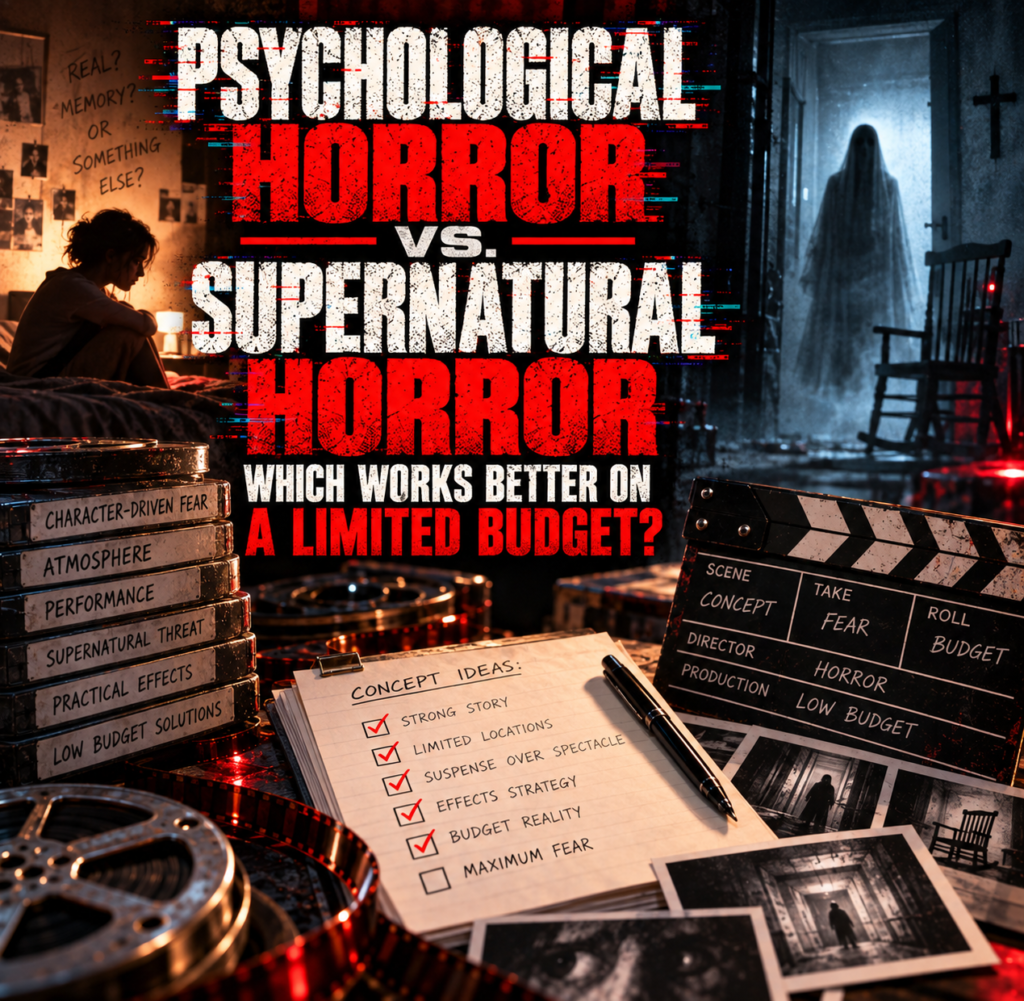
Psychological Horror vs. Supernatural Horror: Which Works Better on a Limited Budget?
Low-budget horror doesn’t have to look small. The real challenge is choosing a concept whose scares, characters, and production requirements work together rather than fighting against the resources available.
Quick Answer: Psychological horror can be especially production-friendly because it often creates fear through character, uncertainty, atmosphere, and performance rather than extensive effects. Supernatural horror can also work extremely well on a limited budget when the threat is suggested strategically and the story relies on suspense rather than constant spectacle. Neither subgenre is automatically cheaper—the concept and execution determine the production demands.
One of horror’s greatest strengths is its ability to create a powerful audience experience without always requiring enormous scale.
A frightened character walking through a dark house can generate more tension than a scene involving hundreds of digital creatures.
But when developing horror with production realities in mind, writers eventually confront an interesting question.
Is psychological horror or supernatural horror better suited to a limited budget?
The answer depends less on the label and more on how the story creates fear.
What Is Psychological Horror?
Psychological horror focuses heavily on the mind.
Fear may come from paranoia, grief, guilt, obsession, trauma, isolation, distorted perception, or the possibility that a character can no longer trust what they are experiencing.
The central threat doesn’t necessarily need to be imaginary.
What matters is that the character’s psychological state becomes part of the horror.
That can make psychological horror particularly effective when the story is built around:
- Strong performances.
- Uncertainty.
- Atmosphere.
- Character relationships.
- Restricted information.
- A gradual loss of control.
The audience becomes frightened because it experiences uncertainty alongside the protagonist.
What Is Supernatural Horror?
Supernatural horror introduces forces that exist beyond ordinary explanations.
Ghosts, demons, curses, possessions, haunted objects, impossible entities, and unexplained phenomena can all fall within the category.
That sounds as if it would automatically require expensive effects.
It doesn’t.
Some of the most effective supernatural scares come from what audiences don’t see.
A sound upstairs.
A door moving by itself.
A shadow crossing a hallway.
An object appearing somewhere impossible.
A character responding to something outside the frame.
Supernatural horror becomes expensive when the concept demands constant spectacle.
It can remain relatively contained when suggestion does most of the work.
Psychological Horror Can Put Performance at the Center
When a story relies heavily on a character’s deteriorating perception, the actor becomes one of the primary special effects.
The audience studies expressions.
Behavior changes.
Silences become meaningful.
Small inconsistencies become disturbing.
This can allow a filmmaker to generate tension without constantly introducing new visual elements.
But there’s a tradeoff.
If performance and character are carrying the horror, the screenplay has to give actors something compelling to play.
A vague protagonist wandering through dark rooms isn’t automatically psychological horror.
The internal conflict needs structure and escalation just as carefully as an external monster would.
Supernatural Horror Can Make Ordinary Locations Frightening
One advantage of supernatural horror is its ability to transform familiar spaces.
A bedroom.
A hallway.
A kitchen.
A staircase.
A basement.
The location doesn’t need to look extraordinary if something extraordinary is happening inside it.
That can make supernatural horror compatible with contained production strategies.
The screenplay can establish a recognizable environment and then gradually change the audience’s relationship with it.
A door that seemed harmless becomes threatening.
A mirror becomes something characters avoid.
A particular room develops rules.
The supernatural element gives ordinary production spaces new dramatic meaning.
The Cost Often Comes From What the Screenplay Demands
Genre alone doesn’t determine budget.
Execution does.
A psychological horror screenplay involving multiple countries, period settings, hundreds of extras, and elaborate stunts could be extremely expensive.
A supernatural screenplay set primarily inside one house could potentially be far more manageable.
Writers thinking about production scope should examine the actual demands on the page:
- How many locations are required?
- How large is the principal cast?
- How many night exteriors are necessary?
- Are extensive visual effects required?
- Are there complicated stunts?
- Does the creature or entity need to appear constantly?
- Can suggestion accomplish what spectacle is currently doing?
Those questions are often more useful than simply deciding whether a story is psychological or supernatural.
What You Don’t Show Can Save Money and Increase Fear
Horror has one production advantage that few other genres possess.
The audience’s imagination is free.
Writers can use it.
A creature doesn’t always need to appear.
Violence doesn’t always need to happen on screen.
The supernatural event doesn’t always need to be explained.
Sometimes the reaction to an unseen event creates more fear than showing the event itself.
This isn’t merely a way to reduce production demands.
It’s a storytelling technique.
When audiences don’t receive complete information, they begin creating possibilities themselves.
Those possibilities can be more disturbing than anything a filmmaker could show.
Psychological and Supernatural Horror Can Work Together
The two subgenres aren’t opposites.
Some of the most interesting horror stories deliberately blur the boundary.
Is the character losing their mind?
Is the haunting real?
Is grief changing their perception?
Is something supernatural exploiting an existing psychological weakness?
That uncertainty can be extremely effective because the audience has two mysteries to solve.
What is happening?
And can the protagonist’s interpretation of it be trusted?
A story that combines psychological and supernatural horror can create substantial tension without requiring constant visual spectacle.
Atmosphere Is Valuable in Both Subgenres
Whether the threat exists inside a character’s mind or outside the natural world, atmosphere does enormous work.
Lighting.
Sound.
Silence.
Production design.
Framing.
Pacing.
The way a character enters an empty room.
These elements influence how audiences interpret what they’re seeing.
A limited-budget horror screenplay can benefit from creating scenes where tension comes from anticipation rather than expensive action.
If the audience is already afraid before anything happens, the story is doing its job.
Which Is Better for a Limited Budget?
If forced to generalize, psychological horror can sometimes offer an advantage because the story may rely more heavily on performance, character, atmosphere, and uncertainty.
But that doesn’t make psychological horror automatically inexpensive.
And it doesn’t make supernatural horror automatically expensive.
The better question is:
Which version of this story creates the strongest fear with the resources the concept genuinely requires?
If a supernatural premise works best when the entity remains largely unseen, embrace that.
If psychological horror requires one extraordinary location and two exceptional performances, build around those strengths.
Production awareness should sharpen the concept rather than weaken it.
What Writers Should Consider
When developing horror with a limited production scope, writers can ask:
- Where is the fear actually coming from?
- Can character and atmosphere carry more of the tension?
- Does the audience need to see the threat?
- Can one strong location replace several weaker ones?
- Can sound or reaction accomplish more than an effects sequence?
- Does every expensive element genuinely improve the story?
- Would ambiguity make the concept more frightening?
Constraints can force better decisions.
And better decisions often create better horror.
Conclusion
Psychological horror and supernatural horror are both capable of creating enormous fear on a limited canvas.
What matters isn’t which label appears beside the screenplay.
It’s how intelligently the story uses what it has.
As a writer drawn to psychologically grounded horror, I’ve always been interested in the point where external danger and internal fear begin affecting each other. A supernatural threat becomes more frightening when it attacks something emotionally real. Psychological horror becomes more unsettling when audiences can no longer dismiss the possibility that something impossible may actually be happening.
For writers and producers working within a limited scope, that’s the opportunity.
Don’t ask how to make the story feel bigger.
Ask how to make the fear feel bigger.
Frequently Asked Questions
Is psychological horror cheaper to produce than supernatural horror?
It can be, but not automatically. Psychological horror often relies on performance, atmosphere, and uncertainty, while supernatural horror may require additional effects. Locations, cast, stunts, schedule, and the specific concept ultimately have a greater impact on production demands.
Can supernatural horror work on a low budget?
Yes. Supernatural horror can be very effective on a limited budget when filmmakers use suggestion, sound, atmosphere, practical effects, restricted locations, and carefully controlled glimpses of the threat.
What is the difference between psychological horror and supernatural horror?
Psychological horror primarily creates fear through the mind, perception, emotional instability, or internal conflict. Supernatural horror involves forces or phenomena that cannot be explained through ordinary reality. Many horror stories combine elements of both.
Does a horror movie need expensive visual effects to be scary?
No. Suspense, sound, performance, atmosphere, editing, production design, and what remains unseen can all create powerful horror without extensive visual effects.
Can psychological horror include ghosts or supernatural elements?
Yes. Psychological and supernatural horror frequently overlap. Uncertainty about whether a supernatural event is real can become part of the psychological tension.
- Published author with titles including Memorial Day
- Screenwriter developing horror and thriller projects since 2016
- Background in indie film and acting since 2004
- Award-winning script editor focused on psychological horror
- Passionate about creating emotionally grounded horror stories that resonate with audiences.