





Analog Horror Goes Hollywood: Why Internet Horror Is Becoming Valuable Film IP
Some of horror’s most interesting new ideas aren’t beginning in movie theaters. They’re emerging from YouTube videos, fictional broadcasts, corrupted recordings, online mysteries, and strange corners of the internet.
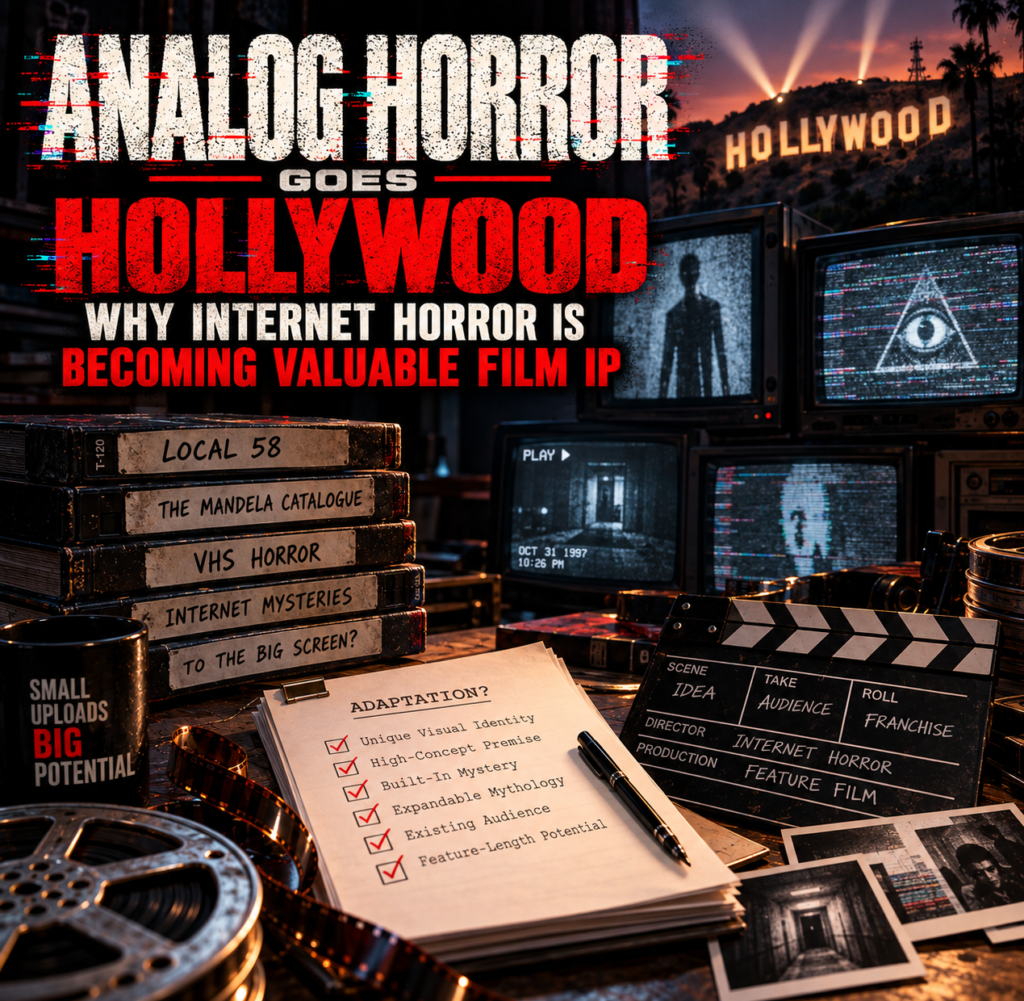
Quick Answer: Analog and internet horror can attract film-industry attention because successful concepts often combine distinctive visual identities, simple high-concept premises, built-in mystery, expandable mythology, and existing audience interest. For producers, the opportunity isn’t simply adapting an online video—it is identifying whether the underlying horror concept can sustain characters, conflict, and a feature-length story.
Horror has always evolved alongside technology.
Radio created new ways to frighten audiences through sound.
Television brought horror directly into the home.
Camcorders helped transform found footage.
Now the internet has created another storytelling language.
Analog horror often imitates old broadcasts, instructional tapes, surveillance footage, public-access television, emergency alerts, corporate training videos, or degraded recordings.
Internet horror expands even further, using social platforms, short-form video, web series, fictional archives, and collaborative mysteries.
The format may feel new.
The fear underneath it isn’t.
It still relies on uncertainty, isolation, forbidden knowledge, and the unsettling possibility that something familiar isn’t what it appears to be.
What Is Analog Horror?
Analog horror is a style of horror storytelling that frequently uses the appearance of older media to create fear.
Instead of presenting events through traditional filmmaking, the story may appear to have been discovered inside:
- VHS recordings.
- Television broadcasts.
- Emergency warnings.
- Training films.
- Security footage.
- Archived recordings.
- Public information videos.
The format creates distance between the audience and the event.
We aren’t necessarily watching the horror happen directly.
We’re watching evidence that something happened.
That distinction can make the experience feel disturbingly real.
The Internet Rewards Strong Horror Hooks
Online audiences make decisions quickly.
A horror idea has to create curiosity almost immediately.
A strange image.
An impossible location.
A disturbing rule.
A face that doesn’t look quite human.
A recording that shouldn’t exist.
That environment naturally rewards concepts that are visually distinctive and easy to communicate.
Those same qualities can be valuable when developing a film.
If the central idea immediately makes someone ask, “What is that?” or “What happens next?” the concept already contains one of horror’s most useful tools: curiosity.
Mystery Creates Audience Participation
Traditional movies usually give audiences a complete narrative experience.
Internet horror can work differently.
Information may be scattered across multiple videos.
Clues may appear in the background.
Dates, symbols, voices, or distorted frames may suggest a larger story.
Fans begin connecting the pieces themselves.
That participation changes the relationship between audience and story.
Instead of simply watching, viewers investigate.
They theorize.
They argue.
They search for details other people missed.
For producers evaluating internet-born horror IP, that kind of engagement can be meaningful because it demonstrates that audiences aren’t merely consuming the concept.
They’re thinking about it.
A Strong Mythology Can Expand Beyond the Original Format
Many successful internet horror concepts suggest a much larger world than they initially reveal.
That can create adaptation opportunities.
A three-minute video may introduce a terrifying idea without explaining:
- Where the threat came from.
- Who first encountered it.
- How long it has existed.
- What rules govern it.
- Who is trying to understand it.
- What happens to someone who encounters it directly.
Those unanswered questions can become raw material for a screenplay.
But expansion has to be handled carefully.
Mystery is often part of what made the original concept frightening.
Explaining everything can destroy the fear.
A Viral Concept Still Needs a Movie Story
Online popularity doesn’t automatically mean a concept can sustain a feature film.
A frightening image might work for thirty seconds.
A mysterious recording might work for five minutes.
A feature screenplay has to sustain attention much longer.
That requires characters.
Goals.
Conflict.
Escalation.
Consequences.
A film adaptation needs to answer a difficult question:
Who experiences this horror, and why should the audience care what happens to them?
The mythology may attract viewers.
The characters keep them watching.
The Best Adaptations Preserve the Original Fear
When an internet horror concept moves into a more traditional narrative format, there can be a temptation to make everything bigger.
More monsters.
More explanations.
More effects.
More mythology.
But bigger isn’t automatically scarier.
If the original concept worked because audiences could only glimpse the threat, showing it constantly may weaken it.
If uncertainty created the fear, explaining the entire mythology may eliminate it.
The challenge is identifying the mechanism that made the original material unsettling and protecting it during expansion.
Sometimes the most important part of an adaptation is what the screenplay chooses not to reveal.
Internet Horror Can Offer a Distinct Visual Identity
Marketing horror often begins with an image.
A mask.
A creature.
A hallway.
A television screen.
A symbol.
A location.
Internet horror frequently develops around strong visual identities because images need to stop someone from scrolling.
That can become valuable beyond the original platform.
A distinctive visual idea can influence:
- Posters.
- Trailers.
- Social media campaigns.
- Teaser imagery.
- Audience discussion.
- The overall identity of the film.
A horror concept audiences can recognize instantly has already accomplished something difficult.
What Producers Can Look for in Internet-Born Horror
When considering whether analog or internet horror could translate into film, the number of views is only one factor.
The deeper questions are about the concept itself:
- Is the central idea immediately understandable and intriguing?
- Does it have a distinctive visual identity?
- Is there enough mystery to support a larger story?
- Can the mythology expand without destroying the fear?
- Can compelling characters be placed inside the concept?
- Does the threat create escalating dramatic possibilities?
- Can the experience work beyond the format that originally made it popular?
Those questions separate a memorable piece of internet horror from potential feature-film material.
What Horror Writers Can Learn From Analog Horror
Writers don’t need to imitate VHS tapes or fictional broadcasts to learn from the format.
The larger lesson is about efficiency.
Analog horror often proves how little information an audience needs before imagination begins doing the work.
A disturbing premise.
A few rules.
One unforgettable image.
A mystery.
The suggestion of something much larger.
Those elements can be powerful in any form of horror storytelling.
Writers should pay attention to how quickly these stories establish unease and how carefully they control information.
Fear often grows in the space between what the audience knows and what it desperately wants to know.
Conclusion
The internet hasn’t reinvented fear.
It has created new ways to deliver it.
What interests me most about analog and internet horror is how often these stories succeed by doing less. They provide fragments, images, warnings, sounds, and mysteries, then allow the audience to participate by imagining what exists outside the frame.
As a horror screenwriter, I think that’s a lesson worth remembering regardless of format.
Technology changes.
Platforms change.
The way audiences discover stories changes.
But mystery remains powerful.
And when an original horror idea is strong enough to make thousands or millions of people wonder what happens next, it’s understandable why filmmakers might begin asking the same question.
Frequently Asked Questions
What is analog horror?
Analog horror is a style of horror that often imitates older media such as VHS recordings, television broadcasts, emergency alerts, surveillance footage, and instructional videos to create mystery and fear.
Why is analog horror popular?
Analog horror often combines familiar media with disturbing or unexplained elements. Its fragmented storytelling also encourages viewers to investigate clues, develop theories, and participate in the mystery.
Can internet horror be adapted into a movie?
Yes, but the concept must usually expand beyond its original format. A feature adaptation needs characters, sustained conflict, escalation, emotional stakes, and enough narrative material to support a full-length story.
What makes internet horror attractive as film IP?
Internet-born horror can offer a recognizable concept, distinctive imagery, expandable mythology, demonstrated audience interest, and a strong central hook that may translate to film.
Does an analog horror movie need to use found footage?
No. The underlying concept or mythology can potentially be adapted into many cinematic styles. The key is preserving what made the original idea frightening rather than reproducing its format mechanically.
- Published author with titles including Memorial Day
- Screenwriter developing horror and thriller projects since 2016
- Background in indie film and acting since 2004
- Award-winning script editor focused on psychological horror
- Passionate about creating emotionally grounded horror stories that resonate with audiences.