





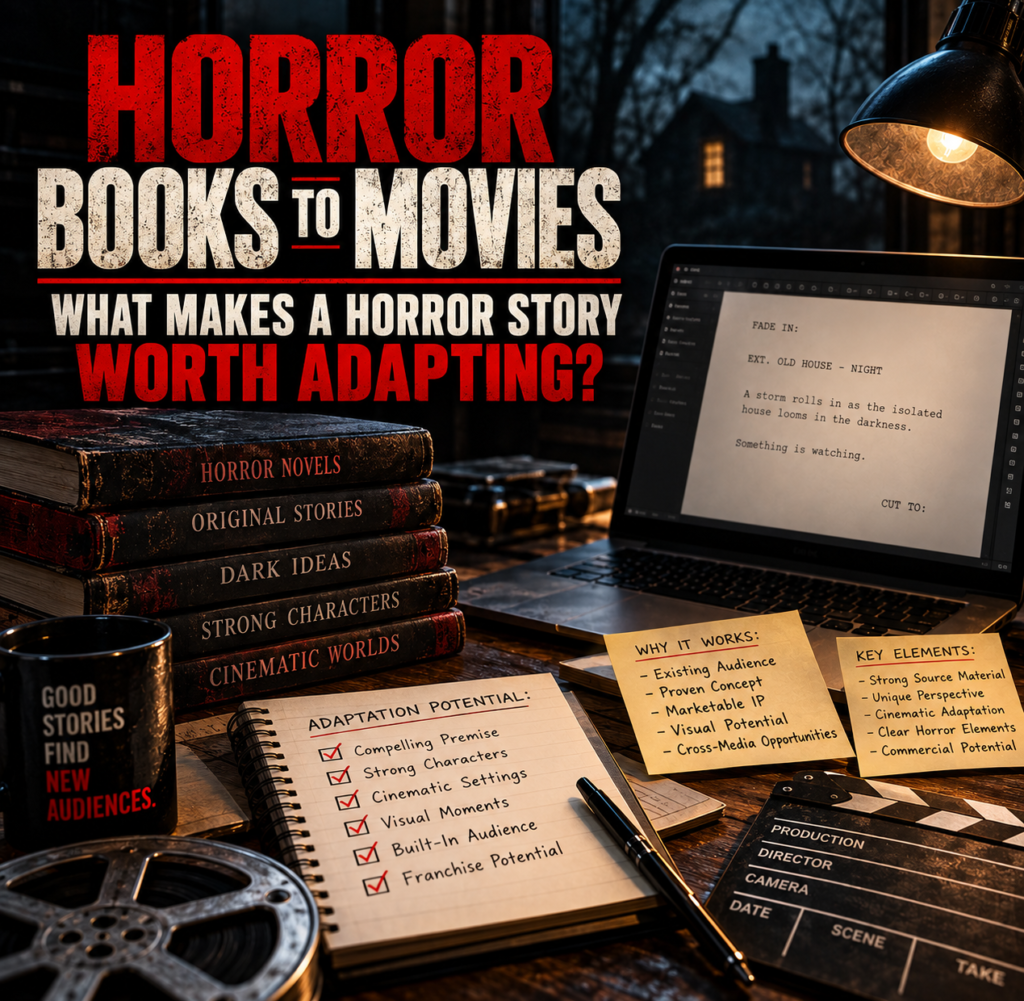
Horror Books to Movies: What Makes a Horror Story Worth Adapting?
A great horror book doesn’t automatically become a great horror movie. The stories with strong adaptation potential usually contain something deeper: a compelling concept that can survive the transition from the reader’s imagination to the screen.
Quick Answer: A horror story can be attractive for film adaptation when it combines a clear central concept, memorable characters, cinematic conflict, strong visual possibilities, emotional stakes, and a production scope that can be translated effectively to film. The best adaptations preserve what makes the original story distinctive while allowing the screenplay to become its own cinematic experience.
Horror has a long relationship with adaptation.
Books and short stories offer filmmakers something particularly valuable: an existing story world, characters, themes, and central idea that can be reimagined visually.
But adaptation isn’t simply a matter of transferring chapters into screenplay format.
Books and movies create fear differently.
A novel can enter a character’s thoughts, spend pages building atmosphere, or allow a reader’s imagination to construct the monster.
A film has to turn those experiences into images, sound, performance, pacing, and action.
That means the most important question isn’t simply whether a horror book is good.
It’s whether there’s a compelling movie hiding inside it.
A Strong Horror Concept Travels Well
One of the first qualities that can make horror IP attractive for adaptation is a concept that can be communicated clearly.
A producer should be able to understand the central dramatic situation without hearing the entire plot.
What is threatening the characters?
Why can’t they simply escape?
What makes this story different from other horror movies?
What is the central question that makes someone want to know what happens?
A clear concept doesn’t mean the story has to be simple.
It means the foundation is strong enough to survive the transition between mediums.
The Story Needs Cinematic Moments
Books can create terror entirely inside a character’s mind.
Movies need something an audience can experience.
That doesn’t mean every horror adaptation needs elaborate effects or constant violence. Some of the most cinematic moments in horror are remarkably simple.
A door that shouldn’t be open.
A figure standing where nobody was moments earlier.
An object appearing in the wrong place.
A character realizing someone else is inside the house.
When considering adaptation potential, it helps to ask whether the story naturally produces scenes that can be communicated through images, sound, behavior, and atmosphere.
The more visually expressive the central conflict becomes, the easier it is to imagine the story as a film.
Characters Give the Horror Meaning
A frightening premise can attract attention.
Characters make an audience care.
Horror becomes more powerful when the threat attacks something emotionally important to the protagonist.
That might be:
- A family relationship.
- A painful memory.
- A secret.
- A fear of failure or abandonment.
- Grief or guilt.
- A desperate need to protect someone.
Without that emotional foundation, even an inventive monster or supernatural threat can begin to feel mechanical.
For adaptation, strong characters also give actors meaningful roles and give the screenplay a dramatic engine beyond simply surviving the next scare.
Not Everything in the Book Needs to Be in the Movie
One of the biggest mistakes in adaptation is treating every scene from the source material as untouchable.
Books and movies operate differently.
A subplot that works beautifully across several chapters may slow down a feature film.
A character who exists primarily to deliver information may need to be combined with another character.
Internal narration may need to become visual action.
Locations may need to change.
Events may need to happen sooner.
The goal isn’t necessarily to reproduce every page.
It’s to identify the emotional and thematic core of the story and determine how to express that core cinematically.
Sometimes respecting a book means knowing what has to change.
A Distinctive Horror World Can Become Valuable IP
Adaptation potential isn’t limited to plot.
Sometimes the most valuable element is the world surrounding the story.
A memorable mythology, creature, location, set of supernatural rules, or unexplored history can create possibilities beyond a single narrative.
That doesn’t mean every horror property needs to become a franchise.
It means producers can look at whether the concept has enough depth to generate curiosity beyond the immediate story.
Audiences often respond to horror worlds that suggest there is more happening beyond what they can currently see.
Mystery creates imagination.
And imagination can make a fictional world feel larger than the film itself.
Production Scope Still Matters
A brilliant horror novel may contain hundreds of characters, dozens of locations, multiple timelines, enormous creatures, and events spanning generations.
A screenplay eventually has to become a production.
That makes scope important.
An adaptation doesn’t necessarily need to recreate everything at the scale described on the page.
A screenwriter can sometimes concentrate the story around:
- Fewer primary locations.
- A more focused group of characters.
- A shorter timeline.
- A central threat rather than multiple competing storylines.
- Practical suspense instead of constant spectacle.
The goal isn’t to make every story smaller.
It’s to determine what the movie actually needs in order to preserve the experience that made the original material compelling.
Short Stories Can Have Powerful Adaptation Potential
A story doesn’t need to be a 400-page novel to contain the foundation of a feature film.
Short fiction can sometimes provide an especially strong starting point because it may already be built around a concentrated premise.
The adaptation can then expand the characters, mythology, conflict, and consequences around that central idea.
What matters isn’t page count.
It’s whether the underlying concept creates enough dramatic possibilities to sustain a movie.
A ten-page story with an unforgettable premise can contain more cinematic potential than a much longer work without a clear dramatic engine.
The Best Adaptations Understand What Made the Original Scary
Before changing a story for film, a writer has to understand why the original works.
Is the fear coming from uncertainty?
Isolation?
A monster?
Psychological deterioration?
Family conflict?
The possibility that the protagonist can’t trust their own perception?
That source of fear is the DNA of the story.
Individual scenes can change while that DNA remains intact.
If an adaptation preserves the plot but loses the thing that made the original frightening, it may technically resemble the book while failing to recreate its experience.
What Producers Can Look for in Horror IP
When evaluating a horror story for possible adaptation, several questions can help reveal its cinematic potential:
- Can the central concept be explained clearly?
- Does the story contain memorable visual situations?
- Are the characters emotionally connected to the horror?
- Is there a distinctive element audiences can remember?
- Can internal storytelling be translated into cinematic action?
- Can the story be adapted within a realistic production scope?
- Does the world suggest possibilities beyond the immediate plot?
No single answer determines whether a property should become a movie.
But together, these questions help reveal whether the source material contains a strong cinematic foundation.
Conclusion
Adapting horror isn’t about copying a book onto the screen.
It’s about discovering the movie that already exists inside the story.
As both an author and horror screenwriter, I find that distinction especially important. Prose gives a writer access to the reader’s imagination in ways film cannot duplicate. Film gives us images, sound, actors, silence, movement, and the ability to make an audience experience fear together in a dark room.
The strongest adaptation respects both mediums.
It protects the idea, emotion, and fear that made the original story work while giving the screenplay permission to become something cinematic.
Because ultimately, the question isn’t whether every page can make it into the movie.
It’s whether the thing that made readers afraid can survive when the lights go down.
Frequently Asked Questions
What makes a horror book good for film adaptation?
Strong horror adaptation material often combines a clear concept, memorable characters, emotional stakes, cinematic situations, and a story that can be translated effectively from internal prose to visual storytelling.
Does a film adaptation need to follow the horror book exactly?
No. Film and prose tell stories differently. Effective adaptations may combine characters, remove subplots, change locations, or restructure events while preserving the central idea, emotion, and themes of the source material.
Can a horror short story become a feature film?
Yes. A short story with a strong central premise can provide the foundation for a feature screenplay if the concept offers enough character, conflict, mythology, and escalation to support a longer story.
What does horror IP mean?
Horror IP refers to intellectual property connected to a horror story or concept, such as a novel, short story, character, fictional world, or other original material that may potentially be developed for film, television, or other media.
Why are horror books attractive to filmmakers?
Horror books can provide filmmakers with developed characters, concepts, worlds, themes, and source material that can be transformed into a cinematic experience.
- Published author with titles including Memorial Day
- Screenwriter developing horror and thriller projects since 2016
- Background in indie film and acting since 2004
- Award-winning script editor focused on psychological horror
- Passionate about creating emotionally grounded horror stories that resonate with audiences.