





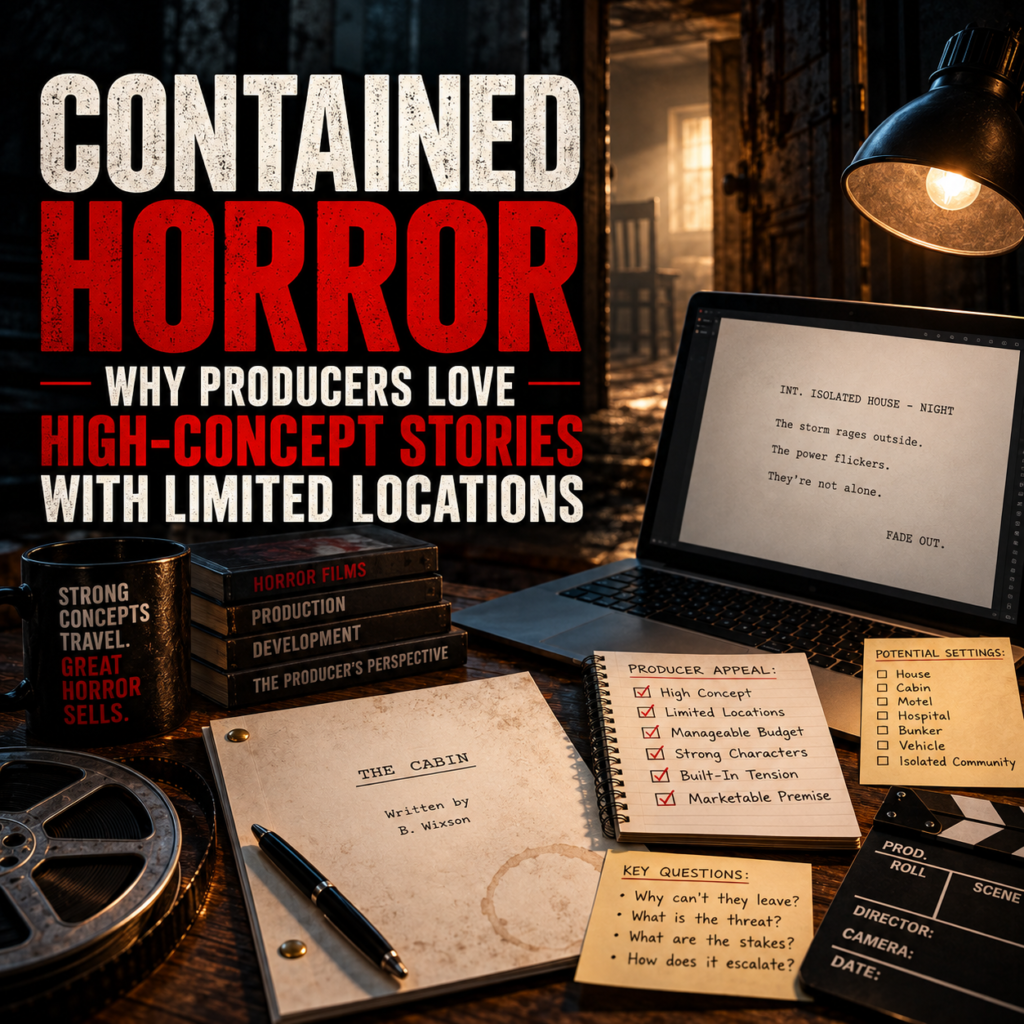
Contained Horror: Why Producers Love High-Concept Stories With Limited Locations
Some of the most effective horror stories don’t need dozens of locations, massive sets, or enormous budgets. They need a compelling idea, escalating tension, and nowhere for the characters to escape.
Quick Answer: Contained horror appeals to producers because it can combine a strong commercial concept with a manageable production footprint. Limited locations can reduce logistical complexity while giving writers an opportunity to create intense, character-driven stories built around isolation, tension, and escalating danger.
Horror has always had an unusual advantage as a film genre: bigger doesn’t necessarily mean scarier.
A story can trap its characters inside a house, cabin, motel, hospital, bunker, vehicle, or other isolated location and still create a world that feels enormous to the audience.
In fact, limitations can sometimes make horror more effective.
When characters can’t simply leave, the location stops being a backdrop and becomes part of the threat.
For producers searching for original horror material, that combination can be particularly attractive: a concept that’s easy to understand, a story that feels cinematic, and a production scope that doesn’t automatically require a blockbuster budget.
That’s the power of contained horror.
What Is Contained Horror?
Contained horror is a horror story built primarily around a limited number of locations, characters, or production elements.
That doesn’t necessarily mean the entire movie takes place in one room.
A contained horror screenplay might take place inside:
- A remote house or cabin.
- An apartment building.
- An abandoned facility.
- A hospital or institution.
- A motel or roadside location.
- A vehicle, ship, or isolated structure.
- A small community cut off from the outside world.
What matters is that the story establishes clear boundaries.
The characters are trapped physically, psychologically, or both.
Those boundaries create one of horror’s most useful ingredients: pressure.
Why Contained Horror Can Appeal to Producers
Every screenplay eventually has to confront the realities of production.
Locations need to be secured. Sets need to be built or dressed. Cast members need to be scheduled. Crews and equipment need to move. Effects need to be created.
Complexity can become expensive very quickly.
A contained horror screenplay may reduce some of those variables.
Fewer locations can mean fewer company moves. A focused cast can simplify scheduling. A story built around atmosphere and suspense may rely less heavily on large-scale spectacle.
None of this guarantees that a contained horror movie will be inexpensive to produce.
A single-location film can still become costly depending on visual effects, stunts, cast, production design, shooting schedule, or other requirements.
But a screenplay that delivers a compelling experience without automatically demanding enormous production resources can give producers more options.
A High-Concept Premise Makes Containment Stronger
A limited setting alone isn’t a concept.
Putting five characters inside a cabin doesn’t automatically create an interesting horror movie.
The real opportunity comes when containment is combined with a premise audiences can understand quickly.
Imagine the difference between:
People become trapped inside a building.
and:
People become trapped inside a building where something terrifying happens whenever the lights go out.
The second version immediately creates questions.
What happens in the darkness?
Why can’t they leave?
How long can they keep the lights on?
What happens when the power begins failing?
That’s the foundation of high-concept horror: a central idea that can be communicated clearly while creating numerous possibilities for conflict.
For producers, a concept that’s easy to understand can also be easier to discuss, pitch, package, and eventually market.
Limited Locations Can Increase Tension
Horror thrives on removing options.
If characters can easily escape danger, call for help, or move somewhere safe, much of the tension disappears.
Contained horror does the opposite.
It closes doors.
The audience understands the geography of the location and gradually realizes how few choices remain.
A hallway that seemed ordinary twenty minutes earlier can become terrifying once the audience knows what’s waiting at the other end.
A locked door can become either protection or a trap.
A basement can become the last place anyone wants to enter—and eventually the only place left to go.
As the story progresses, the physical space feels smaller.
That’s where containment becomes more than a production consideration.
It becomes a storytelling weapon.
The Location Should Become Part of the Story
The strongest contained horror stories don’t simply happen in a location.
They use the location.
Every environment offers possibilities.
An old house might contain hidden rooms, failing electricity, narrow hallways, or decades of history.
A hospital might provide empty wards, medical equipment, locked sections, and institutional isolation.
A motel might create separate rooms, unknown guests, surveillance opportunities, and the unsettling feeling of being somewhere temporary.
Writers should ask:
- What makes this location visually distinctive?
- What areas feel safe at the beginning?
- How can those safe spaces become dangerous?
- What resources can the characters lose?
- What secrets can the environment reveal?
- How does the location become more threatening as the story progresses?
If the story could be moved to any random building without changing anything, the location probably isn’t doing enough work.
Containment Forces Characters Into Conflict
A monster outside the door is frightening.
Being trapped inside with people you no longer trust can be even worse.
Contained horror naturally creates interpersonal pressure because characters can’t easily separate from one another.
Fear begins exposing weaknesses.
Secrets emerge.
Alliances shift.
People make selfish decisions.
Someone inevitably believes they know how to survive while someone else believes the exact opposite.
That conflict gives a contained horror screenplay another advantage: the threat doesn’t have to carry every scene.
The characters can generate tension themselves.
When done well, the external horror and internal conflict begin feeding each other.
Contained Horror Still Needs Escalation
One of the biggest challenges with a limited-location screenplay is repetition.
If characters spend too much time hiding from the same threat in the same environment, tension eventually becomes predictable.
A contained horror story still needs to evolve.
The danger should change.
The characters’ understanding of the situation should change.
The environment should change.
The cost of survival should increase.
Escalation might involve:
- A supposedly safe area becoming compromised.
- A character discovering new information about the threat.
- Resources beginning to disappear.
- An escape route becoming impossible.
- Conflict dividing the survivors.
- The rules of the threat changing or becoming clearer.
Containment works best when the audience feels the walls gradually closing in.
Small Scale Doesn’t Mean Small Stakes
A horror movie doesn’t need the world to be ending for the stakes to feel enormous.
For the person trapped inside the story, survival is already enormous.
The key is making the audience care about who is trapped.
If viewers become emotionally invested in a character, one locked room can create more tension than an entire city being destroyed.
That’s why character development matters so much in contained horror.
The smaller the physical canvas becomes, the more attention the audience can give to behavior, relationships, fear, guilt, grief, desperation, and survival.
Production scale may be contained.
Emotional scale doesn’t have to be.
Why Original Contained Horror Remains Attractive
Horror audiences are unusually receptive to unfamiliar characters and original premises.
A compelling concept can often be the attraction.
That creates opportunities for writers to build stories around a strong hook rather than relying entirely on established characters or enormous fictional worlds.
Contained horror can be especially effective because the premise itself often becomes the marketing engine.
A simple question can sell the experience:
What would you do if you couldn’t leave?
What if the only safe room stopped being safe?
What if something outside knew exactly where you were?
What if the people trapped with you were more dangerous than the thing hunting you?
Those questions create curiosity.
And curiosity gets people leaning forward.
What Horror Writers Should Remember
Writing contained horror isn’t about making a story cheap.
It’s about making every element earn its place.
The setting should create tension.
The characters should create conflict.
The concept should generate possibilities.
The threat should escalate.
And the limitations should make the story stronger rather than simply smaller.
For writers developing contained horror screenplays, several principles are worth remembering:
- Start with a concept that can be explained clearly.
- Give the location a specific identity.
- Build limitations into the conflict.
- Use character relationships to generate additional tension.
- Keep changing the audience’s understanding of the danger.
- Escalate even when the characters can’t change locations.
- Think about production realities without sacrificing the story.
A limited setting should never feel like a creative limitation.
Ideally, it should feel like the reason the movie works.
Conclusion
Contained horror demonstrates one of the things I’ve always found most interesting about the genre: limitations can create opportunities.
You don’t necessarily need a massive world to tell a frightening story.
Sometimes all you need is the right location, the right characters, a strong central idea, and a reason they can’t leave.
From a writing perspective, that forces every scene to work harder. From a production perspective, it can create a screenplay whose ambition comes from its concept and execution rather than its physical scale.
As a horror screenwriter, I believe some of the strongest genre concepts begin with a simple question: what happens when you place believable characters in an impossible situation and slowly remove every way out?
When the answer is compelling enough, a small space can become a very big movie.
Frequently Asked Questions
What is a contained horror movie?
A contained horror movie tells most of its story within a limited number of locations and often uses isolation, restricted movement, or limited resources to increase tension.
Why do producers like contained horror screenplays?
Contained horror can offer producers strong concepts with potentially manageable production requirements. Limited locations and focused casts may reduce logistical complexity while still allowing for a cinematic, marketable story.
Does contained horror have to take place in one location?
No. A contained horror story can use several locations while maintaining a limited overall production footprint. The important element is that the story creates clear boundaries that restrict the characters and concentrate the conflict.
What makes a contained horror concept work?
Strong contained horror usually combines a clear premise, distinctive setting, escalating threat, meaningful character conflict, and a believable reason the characters cannot simply escape.
Is contained horror the same as low-budget horror?
Not necessarily. Contained stories may be designed with production efficiency in mind, but limited locations do not automatically make a film inexpensive. Cast, effects, stunts, production design, schedule, and other factors can significantly affect the final budget.
- Published author with titles including Memorial Day
- Screenwriter developing horror and thriller projects since 2016
- Background in indie film and acting since 2004
- Award-winning script editor focused on psychological horror
- Passionate about creating emotionally grounded horror stories that resonate with audiences.