





How to Write a Horror Screenplay That Actually Sells (2026 Guide)
Most horror screenplays don’t fail because they aren’t scary—they fail because they aren’t marketable.
Quick Answer: A horror screenplay sells when it combines a clear high-concept hook, strong emotional stakes, and a production-friendly structure that appeals to both producers and audiences.
In today’s film and streaming landscape, producers aren’t just looking for fear—they’re looking for clear concepts, contained production scope, and stories that can realistically be made.
If you want to write a horror screenplay that actually sells, you need to think beyond storytelling and start thinking like a filmmaker, a producer, and a buyer.
What Makes a Horror Screenplay Sell?
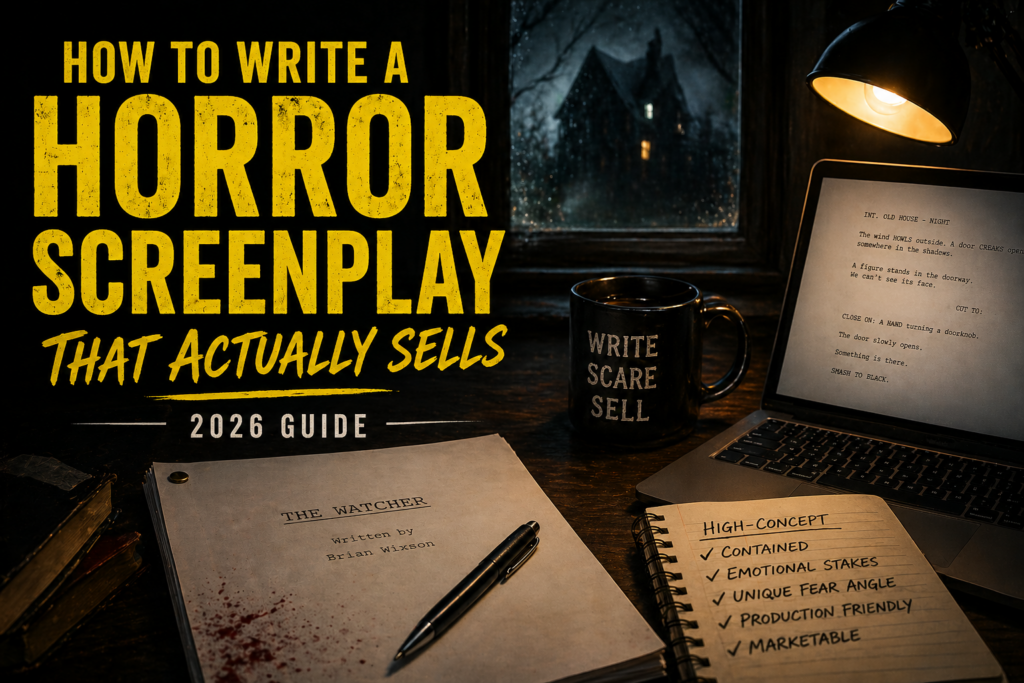
A horror screenplay sells when it combines a high-concept hook, strong emotional stakes, contained production requirements, and a unique fear angle that can be marketed clearly to a specific audience.
1. Start With a High-Concept Idea
If your story can’t be pitched in one sentence, it’s going to struggle.
Weak concept: A group of people experience strange events.
Strong concept: A grieving mother receives phone calls from her dead son—each one predicts a death.
That’s the level of clarity and intrigue producers respond to.
2. Contained Horror Is Easier to Sell
One of the biggest advantages in horror is that low-budget films can generate massive returns.
That’s why contained horror is in demand.
- Limited locations (one house, one building)
- Small cast
- Minimal visual effects
The easier your script is to produce, the more attractive it becomes.
3. Make the Fear Specific
Generic horror ideas don’t stand out. Specific ones do.
- A presence that only appears in reflections
- An entity that mimics loved ones
- A force that manipulates time or memory
Specificity creates originality—and originality gets attention.
4. Build Around Character, Not Just Events
The best horror doesn’t just scare—it connects emotionally.
- What is your character afraid of before the story begins?
- How does the horror exploit that fear?
When fear is personal, the story becomes far more powerful.
5. Think Like a Producer
Writers who understand production realities have an edge.
- Avoid constant location changes
- Avoid large-scale destruction
- Avoid heavy CGI dependence
Focus on tension, atmosphere, and execution.
6. Align With What’s Working Right Now
- Psychological horror
- Contained survival horror
- Elevated horror with deeper themes
- Adaptation-ready concepts
Understanding the market increases your chances of getting noticed.
7. Your Script Is Also a Product
- Is the title compelling?
- Can it be summarized in one sentence?
- Is the concept visually intriguing?
If it’s hard to pitch, it’s hard to sell.
8. Leave Room for Expansion
- Is there a deeper mythology?
- Could this expand into sequels or a series?
Studios value ideas that can grow.
Final Thoughts
Selling a horror screenplay isn’t about writing the scariest story—it’s about writing the most viable one.
Focus on concept, clarity, and execution, and you’ll dramatically increase your chances of getting read—and produced.
Frequently Asked Questions
What makes a horror screenplay sell?
A horror screenplay sells when it combines a strong high-concept idea, clear marketability, contained production scope, and a unique fear angle that stands out to producers and audiences.
How long should a horror screenplay be?
Most horror screenplays are between 90 and 110 pages. Shorter scripts are often preferred for pacing and lower production costs.
What is a contained horror film?
A contained horror film is a story set in a limited number of locations with a small cast, making it easier and more cost-effective to produce.
Are horror movies easier to sell?
Horror films are often easier to sell than other genres because they can be produced at lower budgets while still delivering high returns.
Do you need experience to sell a horror screenplay?
No, but having a strong concept, a polished script, and an understanding of the market significantly increases your chances of selling.
- Published author with titles including Memorial Day
- Screenwriter developing horror and thriller projects since 2016
- Background in indie film and acting since 2004
- Focuses on high-concept, psychologically driven horror IP
- Active in the film and writing community (NY/NJ)